Essaouira guide
Essaouira in 3 Days: What to Actually Do
Three days is the length of stay Essaouira handles best. It is small enough that you can see the whole town on foot, and full enough that a rushed day trip from Marrakech misses everything that makes people come back. Most three-day itineraries treat it like a checklist of monuments. It is not one. It is a working fishing port inside an 18th-century fortress, and the plan that works is built around the wind and the light, not around opening hours.
Before you plan anything: how the town actually works
Four things shape every itinerary here, and knowing them saves you a wasted afternoon.
- The medina is walkable end to end in about 20 minutes. Cars cannot enter most of it. You will not need a taxi for anything inside the walls, and you should not book a hotel far outside them for a three-day trip.
- The wind arrives in the afternoon. Essaouira sits in the path of the Atlantic trade winds, which is why it became a windsurf and kitesurf capital. From spring to early autumn the bay is usually calm in the morning and blowing hard by early afternoon. Plan water time before lunch and town time after it.
- Everything closes and reopens around the middle of the day. Souks thin out, then refill in the late afternoon. The last two hours before sunset are the best hours in the medina, every single day.
- Friday is quieter. Many family-run shops and workshops close for part of the day. It is a good Friday to leave town, and a bad Friday to plan your souvenir shopping.
Day 1: the medina, the ramparts, the port at sunset
Arrive, drop your bag, and do not go to the beach yet. Day one is for orientation, and Essaouira orients you quickly because it is built on a grid, which is rare for a Moroccan medina and makes it almost impossible to get properly lost.
Late morning. Start at Place Moulay Hassan, the open square where the medina meets the port. Walk north up Avenue de l'Istiqlal and then into the smaller streets around Rue Sidi Mohammed Ben Abdallah. This is where the woodworkers are: Essaouira has worked thuya wood for generations, and the workshops open straight onto the street, so you watch the pieces being inlaid before anybody tries to sell you one.
Early afternoon. Walk the Skala de la Ville, the sea bastion on the north-west wall lined with old bronze cannons. It is free, it takes fifteen minutes, and the view along the ramparts is the one you have already seen without knowing where it was. From there, drift down into the Mellah, the old Jewish quarter, which is the quietest and most weathered corner of the walls.
Late afternoon. The fishing port. Blue boats, gulls, the auction winding down, and a row of open-air grills where you pick your fish by weight and they cook it in front of you. Agree the price before it goes on the fire, always. It is the most photographed hour of the day here, and worth timing your first day around.
Evening. Get above the streets. Rooftop culture is the thing Essaouira does better than any other Moroccan coastal town: the medina is low, uniformly white and blue, and the ocean is on three sides, so almost any terrace gives you the sunset. Ours at Chill Art Hostel has a 360° view over the rooftops and the water, and we put tea out for everyone at 18:00, which is roughly when the light goes gold.
Day 2: the bay, the water and the afternoon wind
Day two belongs to the beach, in the morning, for the reason explained above.
Morning. The bay of Essaouira is a long sandy beach break with no reef and a gentle shelving bottom, which is why it is used for first surf lessons rather than for serious waves. If you have never surfed, this is a genuinely good place to start: a two-hour group lesson with board and wetsuit is the standard format, and the Atlantic here is cold enough year-round that the wetsuit is not optional. If you already ride, October to March is the cleaner swell window, and April to September is the wind window for kitesurf and wingfoil.
Lunch. Back inside the walls. A tagine and a bread basket at a small place off the main streets, or a bowl of harira and a couple of sardine sandwiches at the food stalls, will cost you a fraction of what the terraces on the square charge for the same thing.
Afternoon. This is when the wind makes the beach unpleasant for anyone not attached to a kite, so go back into the medina. Good afternoon options, in rough order of how often our guests come back happy from them:
- A hammam. The traditional scrub-and-steam is a two-hour reset, and after a first surf lesson your shoulders will thank you for it.
- A cooking class. The good ones start at the market with the shopping, not in the kitchen. You learn what actually goes into a tagine, and you eat what you made.
- The art galleries. Essaouira has an unusually dense painting scene for a town this size, most of it self-taught and Gnaoua-influenced, and most galleries are free to walk into.
- Henna, or simply the souks again. The second pass through a souk is always better than the first, because you have stopped being overwhelmed by it.
Evening. Music. Essaouira is the home of the Gnaoua World Music Festival each June, and the tradition it celebrates is not seasonal: there is live Gnaoua somewhere in the medina most nights of the year, in cafés and small venues rather than concert halls. Ask locally on the day, because it moves.
Day 3: out of the walls
Three days is exactly enough to earn one trip outside the ramparts, and you have three sensible choices. Pick one, not two.
| Option | Roughly | Best for |
|---|---|---|
| Sidi Kaouki | 25 to 30 minutes south by road | An empty windswept beach, a few cafés, horses and camels on the sand. The classic half-day. |
| Diabat and the Ksob river mouth | Under 15 minutes, walkable along the beach at low tide | The ruined Borj el Baroud in the dunes, birdlife on the estuary, a half-day on foot with almost nobody around. |
| Argan cooperatives on the Marrakech road | 20 to 40 minutes inland | Seeing the oil actually pressed by hand, usually by a women's cooperative. Short, and it pairs well with anything else. |
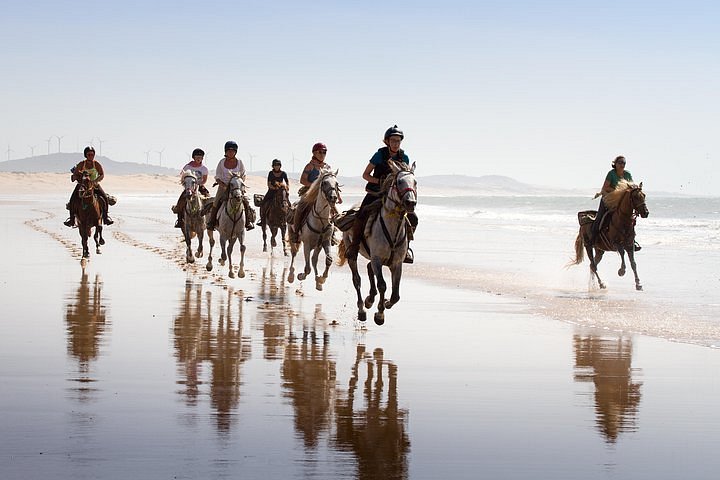
The most Essaouira version of day three, if you only do one thing: ride out along the beach. Horse riding on the sand and into the dunes south of town is the local speciality, it needs no experience, and it covers ground you could not reach on foot. Camel rides run the same stretch and are slower and cheaper.
Get back for the last afternoon in the medina. Buy the thuya box, the argan oil and the raffia shoes on day three rather than day one, because by then you know what things cost.
Would rather not build the plan yourself?
Our three-night packages are this itinerary with the activities already booked: three nights, one activity per day, accommodation and gear included. Surf, kite or cooking. Tell us your dates and we will tell you honestly what the wind is likely to do that week.
Ask us on WhatsApp See the packagesThe three days at a glance
| Morning | Afternoon | Evening | |
|---|---|---|---|
| Day 1 | Arrive, Place Moulay Hassan, the woodworkers' souk | Skala de la Ville, the ramparts, the Mellah | Fish grills at the port, sunset from a rooftop |
| Day 2 | Surf lesson or a long walk on the bay | Hammam, cooking class or galleries, once the wind is up | Live Gnaoua somewhere in the medina |
| Day 3 | Sidi Kaouki, Diabat or horses on the beach | Back in town, last souk pass, shopping | Whatever you liked most on day one, again |
If you are turning this into a package, the shape maps directly onto how ours are priced: three nights means three activities, one per day. Surf is 1 230 DH per person in a dorm for three nights, or 2 700 DH total for two people in a private room. Kite and wingfoil are 1 980 DH and 4 200 DH for the same thing, because the gear costs more. Cooking sits at 1 380 DH and 2 700 DH. All of that includes the bed, the activities, taxes, Wi-Fi, the kitchen and the rooftop.
What actually breaks this plan
Four honest warnings, because the good version alone is not useful.
- The wind. It can blow all day, not just the afternoon, and when it does the beach is out. Have the hammam and the cooking class as your fallback rather than your bonus.
- June. The Gnaoua festival is extraordinary and the town is completely full for it. If your dates are in June, book your bed well ahead and expect crowds, or choose different dates deliberately.
- Arriving late from Marrakech. The road takes about 2 hours 30 to 3 hours and the last buses arrive in the evening, which eats day one. If you land at night, stay somewhere with 24h reception and no curfew, and start the itinerary the next morning.
- Check-out times. Ours is 11:30, check-in is 14:00. On a three-night stay that means your last morning is short, so put the thing you care about most on day two, not day four.
Live availability and rates for our own eight rooms are on the direct booking page, and if you would rather ask a person which room suits your dates, WhatsApp gets a faster answer than email.
Frequently asked questions
Is 3 days enough for Essaouira?
Yes. Three days is the length most people find right: one day for the medina, the ramparts and the fishing port, one day for the beach and the water in the morning with the souks or a hammam in the windy afternoon, and one day for a trip outside the walls such as Sidi Kaouki, Diabat or an argan cooperative. Fewer than three days and you skip either the water or the town; more than three and you are settling in rather than visiting, which is a fine thing to do here but a different trip.
Can you visit Essaouira as a day trip from Marrakech?
You can, but the road is about 2 hours 30 to 3 hours each way, so a day trip gives you roughly four hours in town and almost always misses the two best hours, which are the last two before sunset at the port and on the rooftops. Staying at least two nights is what changes the trip.
What is the best time of day to go to the beach in Essaouira?
The morning. Essaouira sits in the path of the Atlantic trade winds and from spring to early autumn the bay is usually calm early and blowing hard by the start of the afternoon. Surf lessons and swimming happen before lunch; the afternoon belongs to kitesurfers, and to everyone else inside the medina.
Do you need a car in Essaouira?
Not inside the town. The medina is walkable end to end in about 20 minutes and cars cannot enter most of it, so everything on a three-day itinerary is on foot. You only need transport for the day-three trip out of the walls, and a shared or petit taxi covers Sidi Kaouki, Diabat and the argan cooperatives easily.
What is the best day trip from Essaouira?
Sidi Kaouki, about 25 to 30 minutes south, is the classic: a long empty windswept beach with a few cafés and horses on the sand. Diabat and the Ksob river mouth are closer, walkable along the beach at low tide, and quieter, with the ruined Borj el Baroud in the dunes. The argan cooperatives on the Marrakech road are the shortest option and combine with either.
How much is a 3-night package at Chill Art Hostel?
Three nights means three activities, one per day, with accommodation, gear, taxes, Wi-Fi, the shared kitchen and the rooftop included. Surf is 1 230 MAD per person in a dorm or 2 700 MAD total for two in a private room; kite and wingfoil are 1 980 MAD and 4 200 MAD; cooking is 1 380 MAD and 2 700 MAD. Packages are arranged directly with the team on WhatsApp at +212 605 815 025.
Three nights, one activity a day, no planning
Tell us your dates on WhatsApp and we will tell you what the wind is likely to do that week. Live availability for all eight rooms is on our own booking page.
See availability Ask on WhatsApp