Practical info
Working Remotely from Essaouira for a Month
A month in Essaouira is one of the easier remote-work experiments you can run in Morocco, and one of the easiest to get wrong. The failure mode is almost never the country. It is booking the wrong kind of room, arriving with a laptop and no second internet path, and discovering on day four that the only quiet place to take a call is a rooftop with the Atlantic wind blowing straight into your microphone. Here is what a month here actually looks like, from people who live in the medina and watch guests try it every season.
Who a month here works for, and who should keep moving
Essaouira is a small walled town on the Atlantic, roughly 2.5 to 3 hours by road from Marrakech. That size is the whole argument in both directions.
It works well if your work is asynchronous or runs on European hours, if you can do most of it from a laptop with headphones, and if you want a routine: the medina is compact enough that you end up with a bakery, a coffee and a beach walk on the same five streets every day.
It works badly if you need six hours of loud video calls in a soundproof room every day, if you need same-day access to an international airport, or if what you actually want is a dense coworking scene with a new co-founder every week. Essaouira's remote-work infrastructure is accommodation and cafés, not a cluster of coworking floors, and places open and close, so check what is running the month you arrive.
The Wi-Fi question, answered honestly
Every remote worker asks the same first question and gets the same useless answer from every hostel on earth: "yes, we have fast Wi-Fi". Ours is listed on the room pages as fast, and that is still not a number you can plan a workday around.
So do what we suggest to anyone booking a long stay anywhere, including here: ask the property to run a speed test and send you the screenshot, from the actual room you are booking, at the hour you would normally be working. A place that refuses is telling you something.
Then build a second path anyway. A local SIM with a data bundle costs very little, works on 4G across town, and turns your phone into a hotspot the one afternoon the line drops during a call. It is the cheapest insurance in your whole budget, and you will also use it on the beach and on the bus to Marrakech.
Where you actually work during the day
A month splits naturally into three kinds of working hours, and you want a base that can give you all three.
| Setting | Good for | Watch out for |
|---|---|---|
| A private room with its own kitchen and terrace | Calls, deep work, early starts, cooking instead of eating out twice a day | The most in-demand unit for long stays, so it goes first. Ask early. |
| A shared living room with sofas and a table | Ordinary laptop hours, writing, the afternoon slump when you want people around | It is a social space, so it is social. Headphones are part of the kit. |
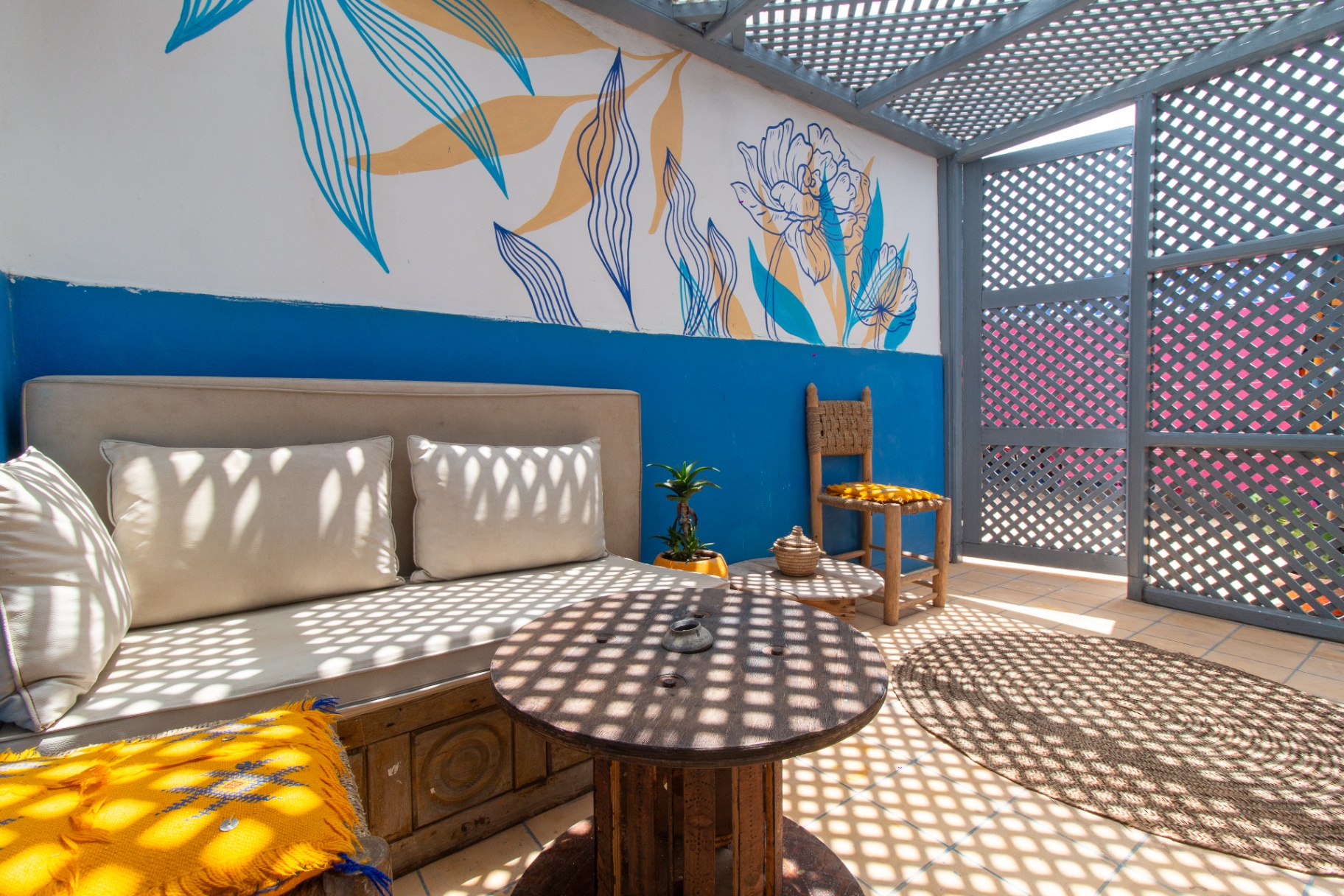
| The rooftop | Golden hour, reading, the end of the day, anything that does not involve a microphone | Wind and glare. Beautiful, but not a call room. |
| Cafés around the medina | A change of scene, an hour of errands-plus-email | Patchy connections. Fine as a supplement, expensive as a strategy. |
At Chill Art Hostel the long-stay answer is L'Appartement: a private apartment with a double bed, an equipped kitchen, a lounge, its own bathroom and a private terrace. It exists because a month is a different thing from three nights. The kitchen is the part people underestimate: it is the single biggest lever on what a month costs.
What a month costs, apart from your bed
Rough monthly ranges in Moroccan dirhams for one person, living normally rather than either splurging or grinding. Prices move, so read this as the shape of the thing rather than a quote.
| Line | Per month (MAD) | Notes |
|---|---|---|
| Food, cooking most meals at home | 1 500 to 2 500 | Market vegetables and fish are cheap, imported anything is not |
| Food, eating out most days instead | 3 000 to 4 500 | The single biggest swing in the whole budget |
| Local SIM and data | 100 to 200 | Your backup connection, and worth every dirham |
| Cafés and coffee | 300 to 600 | Assumes a working coffee most weekdays |
| Laundry | 200 to 400 | Done by the kilo in town |
| Local transport | 100 to 300 | You walk almost everywhere; petit taxis are for the bus station and the airport |
Everything except accommodation therefore lands somewhere around 2 200 to 4 000 MAD a month if you cook, and meaningfully more if you do not. Accommodation is deliberately not in that table: our nightly rates live on the booking engine rather than in a blog post, and long stays are worth asking about directly because a month is not simply thirty times one night for anybody.
Thinking about a month rather than a weekend?
Tell us your dates and how you work. We will tell you which room actually fits, whether the apartment is free, and what the month would look like. If you would rather bundle lessons into it, the packages are built the same way: one activity per day.
Ask us on WhatsApp See the packagesThe time zone is the underrated part
Morocco runs on UTC+1 all year, and moves back an hour to UTC for the duration of Ramadan. Because Europe changes its clocks twice a year and Morocco does not, the overlap shifts with the season: in the European winter you are on the same clock as Paris and Madrid and an hour ahead of London, and in the European summer you are an hour behind them.
In practice that means a European team never has to think about where you are. A Moroccan morning is a European morning. For anyone working with the US east coast, the arithmetic is even better: your mornings are entirely your own, calls start in the afternoon, and you get the best part of the day, which here is the part before the wind picks up.
Most remote guests converge on the same schedule within a week: work early, break in the middle of the day when the light is hard and the wind is strong, work again late afternoon, stop for tea on the roof. Tea time here is every day at 18:00 and free, a small thing that quietly becomes the anchor of your day.
Making it a month, not just thirty days at a desk
The people who leave saying it was the best month of their year all did the same thing: they booked something that was not work into every week. Not a lot. One thing.
- Learn something with a fixed schedule. Surf, kitesurf or wingfoil lessons are the obvious ones here because the Atlantic trade winds make this one of Morocco's great wind towns. A weekly lesson gives your month a spine.
- Use the wind season instead of fighting it. Remote workers are the one group for whom the windy months are an advantage: you are indoors in the afternoon anyway, and the bay is at its best exactly when you clock off.
- Cook once a week with someone who knows how. A Moroccan cooking class changes what you do with the market for the rest of the month.
- Leave town on a weekend. Sidi Kaouki, the argan cooperatives on the Marrakech road, the dunes. All are short trips, and they reset the week.
- Take the hammam seriously. A hammam and a massage on a Friday is the local reset button, and after four weeks at a laptop you will understand why.
The other half of it is people. A hostel with a common living room, a rooftop and eight rooms turns over new travellers constantly while you stay put, which is an unusual social position to be in: you become the person who knows where things are. Two resident cats included, whether you asked for them or not.
The practical checklist before you book a month
- Check your own visa allowance. Many passports get a long visa-free stay in Morocco, but the length depends entirely on your nationality, so verify yours with your own foreign ministry rather than with a forum post.
- Buy a SIM in your first 48 hours. Bring your passport, bring an unlocked phone.
- Decide dorm or private before you arrive, not after. Moving rooms mid-month is possible but it is never free, and the private units are the ones that disappear first.
- Plan for cash. There are ATMs in town and many small places are cash only. Here you can settle in cash, by PayPal or by bank transfer, and card payment runs through the booking engine.
- Know the arrival rules. Check-in is from 14:00, check-out is 11:30, reception is staffed 24 hours and there is no curfew, which matters when your flight lands late or your call runs to midnight.
- Ask early. There are eight rooms in total and one apartment. For a month-long stay, the conversation needs to start well before the month does.
If you already know your dates, live availability and rates are on the direct booking page. If your month depends on a question a booking form cannot handle, and for a long stay it usually does, WhatsApp is faster, and you will be talking to the people who will be at reception when you land.
Frequently asked questions
Is the Wi-Fi in Essaouira good enough for remote work?
For laptop work and video calls it is generally fine in the medina, but quality varies building by building rather than street by street, so treat any property's claim of fast Wi-Fi as a starting point. Ask for a speed-test screenshot taken in the room you are booking, at the hour you would be working, and carry a local SIM with a data bundle as a backup hotspot. The combination of a fixed line plus 4G tethering is what makes a month here reliable.
What time zone is Essaouira in for remote work?
Morocco is on UTC+1 all year and moves back to UTC for the duration of Ramadan. Because it does not change clocks with Europe, you are on the same time as Paris and Madrid during the European winter and an hour behind them during the European summer. For a US east coast team, Moroccan mornings are free and calls fall in your afternoon.
What does a month in Essaouira cost, apart from accommodation?
As a rough range for one person: 1 500 to 2 500 MAD a month for food if you cook most meals, or 3 000 to 4 500 MAD if you eat out most days, plus roughly 100 to 200 MAD for a local SIM and data, 300 to 600 MAD for cafés, 200 to 400 MAD for laundry and 100 to 300 MAD for local transport. Everything except your bed lands around 2 200 to 4 000 MAD a month if you cook. Prices move, so treat these as ranges rather than quotes.
Does Chill Art Hostel have a room suited to a long stay?
Yes. L'Appartement is a private apartment with a double bed, a fully equipped kitchen, a lounge, its own bathroom and a private terrace, and it is the unit built for long stays. There is also a shared living room with sofas and a rooftop with a 360 degree view over the medina and the ocean. With only eight rooms in the house, a month-long stay is worth asking about early on WhatsApp at +212 605 815 025.
Is a hostel a realistic place to work for a month?
It depends on the room, not on the word hostel. A dorm bed works for asynchronous laptop work if you have headphones and use the common areas during the day, but a month of daily video calls needs a private room with a door. The practical advantages of a hostel over an apartment rental are a staffed reception 24 hours a day, no curfew, a shared kitchen and a constantly renewed set of people to have dinner with when you have been alone with a laptop since morning.
Book the month, not just the first night
Live availability and rates on our own booking page, and a real person on WhatsApp to work out which room fits the way you actually work.
See availability Ask on WhatsApp