Essaouira guide
Best Photography Spots in Essaouira
Essaouira photographs well for a plain reason. It is a small walled port: white walls, blue boats, a rampart over the Atlantic, and a beach you can walk to. It photographs badly if you treat it like a studio. The wind arrives, the sand moves, and the people in the frame are working. This page is the public places, the hour that suits each one, and how to keep a camera working. The hour-by-hour town plan is the three-day itinerary. Trips outside the walls are the day trips guide. Whether the town suits you at all is a separate question. This page stays in town, with a camera.
1. Five public places, and nothing you have to pay to enter
The medina is a UNESCO World Heritage site and a working town. The ramparts, the fishing port and the beach do not charge an entrance. From inside the walls the beach is a five to fifteen minute walk. The ramparts and the port are closer than that. You do not need a ticketed viewpoint to make the picture.
- The ramparts and the skala. The sea wall, the cannons, the gulls, the Atlantic. First light, and again at the end of the day.
- The port. Blue fishing boats, nets, the fleet coming back in the morning. A working harbour.
- The alleys and the blue doors. Shade and colour, in streets where people live. The medina is a grid and takes about twenty minutes to cross.
- The beach in the last light. The long sand south of the walls, with the ramparts behind the bay once the sun is low.
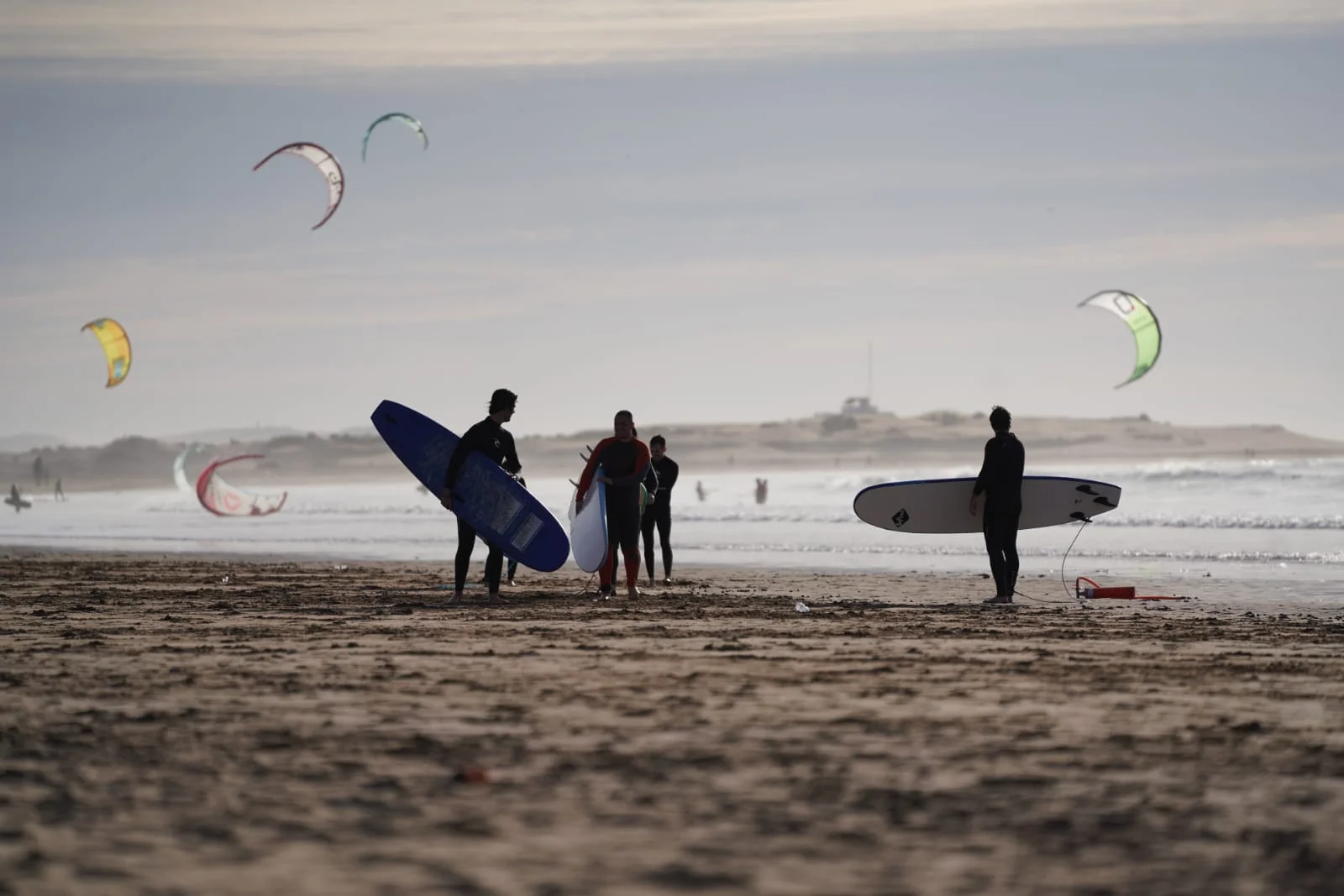
- The wind and the riders. Afternoon in the windy months. The useful frame of a rider is from the water, which means being in the session. That part is at the end.
The ruined fort at Diabat, about an hour's walk south, is the other frame people ask about. It belongs in the day trips guide, with the note on the river mouth and the lack of shade. This page does not repeat it.
2. Light and timing, without a clock time we would be inventing
Sunrise and sunset move through the year. A time printed here would be wrong on the day you go. Use the shape of the day. The month-by-month wind is in the seasons guide. The camera version is shorter.
- First light. The port and the lanes. The fleet is a morning event. The alleys are still in shade, which is what white walls need, and the wind has usually not filled in.
- Late morning. A kind hour on the skala if you want the wall and the water before the sunset crowd. In the windy months this is also the last calm stretch.
- The middle of the day. Harsh. Whitewash burns out and faces go hard. Useful for a blue door in a shaded lane. A poor hour for the beach and a poor hour for people.
- Afternoon, roughly April to September. The trade winds, the alizés, build through the late morning and the kites go up. This is the hour for action on the bay, and the hour sand starts to travel. July and August are the strongest. From about October to March the wind is lighter and less reliable, and the swell is the point, so a surfer on a wave is an easier picture than a kite in a sand cloud.
- The last light. The last stretch of sun, and the first after sunrise, is the kind light. On this coast that last light falls on the water. From the beach, the ramparts and the riders sit in it. From the skala, you are looking into it. The wall is busy at sunset, so if you want it quiet, give sunrise to the skala and sunset to the beach.
Two days is enough to walk all five places. One evening only gets you the sunset crowd.
3. The ramparts and the skala
The skala is the seafront rampart: a public walk above the Atlantic, with cannons along the wall and gulls using it as a perch. Walk it in either direction. Morning gives you the boats and room to stand. Sunset gives you the colour, and a lot of other people who came for the same thing.
- The parapet is a path. A tripod in the middle of it blocks everyone else. Step aside, make the picture, and get the legs out of the walk.
- Shoot along the wall, not only straight out to sea. The line of cannons and the curve of the rampart do more than a flat horizon.
- The island of Mogador sits off the bay. It lands in the background of frames from the wall and from the beach. You do not need a boat to include it.
- Midday on the pale stone is the hour the highlights go. Come back when the light is lower.
Chill Art Hostel is inside the medina, two minutes on foot from the ramparts and the fishing port, so this is a walk from the door, not a taxi.
4. The port and the fishing boats
The picture is the blue fishing boats, the nets, and the fleet coming in during the morning, with gulls over the water. Watching it costs nothing. Climbing onto a boat, standing in the way of a landing, or putting a lens in someone's face without asking is how a working harbour stops being welcoming.
- Go in the morning. That is when the work is happening. By afternoon the same quay is a quieter picture, and in summer it is a windier one.
- Stay on the public edge. The edge of the quay is enough. You do not need to be on a deck.
- Blue against the town, or against the water. That is the simple frame. The rare angle matters less than being there while the boats are still moving.
- Gulls. They follow the boats and they sit on the wall, and they belong in the picture. They are also bold around food, so do not leave a snack, or the bag with the camera in it, on the wall while you eat.
5. Alleys and blue doors
The medina was laid out as a grid, which is unusual in Morocco. Crossing it takes about twenty minutes, and a loop still ends at a gate you recognise. The colour is real: white walls, blue doors and shutters, shade in the lanes. A door is also someone's house.
- A closed door in a quiet lane, with shade across one side of it, is the picture. Opening it, or waiting for the person who lives there to walk into the frame, is not.
- If a person is recognisable, ask before you photograph them. A child means you ask the adult with them. A no ends it.
- A few streets off the main square, the town looks like itself. The square is the crowded version of the same walls.
- Shaded lanes still hold detail at midday, when the rampart does not. Use the hour that way.
There is not one correct door, and sending people to a private doorway is how a resident stops enjoying the street. Walk, and stop when the light on a door is good and the lane is clear.
6. The beach in the last light, and the wind
The bay is a long sandy beach just south of the walls, partly sheltered by the island of Mogador, with no reef. From the medina, five to fifteen minutes on foot. At the end of the day the light comes onto the water, and anyone still riding is in that light, with the ramparts off to the side.
The wind is the other half of the same beach. From roughly April to September it builds through the day. Mornings are the calm window. Afternoons belong to kite and wingfoil, and they also belong to sand. The Atlantic is cold in every month, which matters if you get in and does not matter if you stay on the sand.
From the sand you mostly photograph backs, spray, and lines crossing other lines. It is a fair picture of the bay. It is a weak picture of a rider. The way to fix that is to be in the water with them, not to stand further down the beach with a longer lens pointed at strangers.
7. Gulls, sand, wind, and asking first
The camera problem on this coast is sand, and wind that moves the sand sideways once the afternoon fills in.
- Do not change lenses on the beach or on the skala in the afternoon. Fit the lens you will use before you leave the lanes, or walk with one lens.
- Open a bag with your back to the wind. A zip bag or a simple rain cover is enough for a walk on the rampart. You do not need a waterproof housing until you intend to get in the sea.
- Wipe sand off the outside of the camera before it goes back in the bag. Blowing on the lens mount pushes grit in.
- Use a strap, on a camera or a phone. The parapet is a drop to rocks and water, and a phone set on the wall is a gift to the wind.
- A tripod helps for the last light on the beach if you step off the walking line. On the skala at sunset it is in the way. Handheld is the better default in a crowd and in a wind.
If you were thinking of a drone, check the local rules before you unpack it. This page is not a reading of those rules, and a busy rampart is a bad place to discover them.
Asking comes before the settings.
- Ask before you photograph a person. That includes fishermen, people selling in the market, and anyone in a lane. A working port is not a costume.
- With children, ask the adult who is with them, and take the no.
- Stay out of the path of a boat being landed or pushed.
- Do not block a lane or the rampart walk while you wait for a clear frame. Step in, shoot, step out.
- A refusal is the end of it. Point the camera at a door, a boat, or the sea.
On the water, or in the market with a camera
Surf from €78 / 820 MAD, Solo, two nights, two sessions. Kite / Wingfoil from €125 / 1 320 MAD. Cooking from €89 / 920 MAD when the picture you want is the market and the plate. Free breakfast is included on every pack. A room with no session is booked on its own.
See the packs Room only8. The frame from the water, and the colour when you stay in town
Shooting the surf and the kite action from the water side is the frame the beach will not give you. You are low, you are among the riders, and the ramparts sit behind them instead of a row of people on the sand. The practical way to be there is to join the session. A phone on a leash, or a housing you already trust in salt water, is the tool. A camera body in the shore break is how a walk ends in a repair.
The Surf pack is the morning version. The bay is a sandy beach break, and a first session uses the inside before the wind fills in, which is also the calmer light. Solo, a dorm bed, two nights and two sessions, from €78 / 820 MAD per person. The board and the wetsuit are included. What those mornings are like is in the first surf-lesson guide.
The Kite / Wingfoil pack is the afternoon version, when the kites are up and the picture from the sand is mostly lines and backs. From €125 / 1 320 MAD, Solo, two nights, two sessions. You say whether you want the kite or the wing. The wing is the small sail you hold, with no lines. The season, and the coast beyond the bay, are in the kitesurfing guide. Sessions in both packs are in Essaouira.
The Cooking pack is the day the beach is the wrong place for a camera: too much wind, flat light, or a wish to point the lens at colour instead of spray. The class is a morning of about three to four hours, the souk and then the dish and then lunch, which is colour you can photograph without sand in the dials. From €89 / 920 MAD, Solo, two nights. The shape of that morning is in the cooking guide. The same rule as the port: ask before you photograph a person at the market.
Free breakfast is included on every pack. Solo is per person. Duo is a private room, and the price on the pack page is the total for two people, not per person. Two nights means two sessions, three nights means three. Taxes are included. The euro amount is what the card charges. The dirham amount is the published price for a bank transfer, and it does not change with the exchange rate. The full set is on the pack page.
Booking is a short form: the pack, Solo or Duo, two or three nights, the arrival date, a name and a phone number. Paying in dirhams uses that page, then a bank transfer arranged with the manager on WhatsApp at +212 600 150 138. A question before you pay goes to reception on +212 605 815 025. Bookings are non-refundable, and that is written on the page before you pay.
A room with no session is a separate stay. Live availability is on the direct booking page. We do not quote nightly rates in a guide. Tell reception what you hope to photograph and we can say whether that week looks like a morning on the water or a week for the port and the lanes.
Frequently asked questions
What are the best photography spots in Essaouira?
Five public places, all inside a short walk and none of them ticketed: the ramparts and the skala above the Atlantic, the fishing port when the blue boats come in during the morning, the medina alleys and blue doors, the beach in the last light, and the bay once the wind fills in and the kites are up. The medina is a grid and takes about twenty minutes to cross. The beach is five to fifteen minutes on foot from inside the walls. The ramparts and the port are closer.
What time of day has the best light for photos in Essaouira?
First light for the port and the shaded lanes, late morning for a quieter walk on the skala, and the last light of the day for the beach, when the sun falls on the water. The middle of the day burns out the white walls. From roughly April to September the wind builds through the late morning, so afternoons are for kite and wingfoil and also for sand. From about October to March the wind is lighter and a surfer on a wave is an easier picture. Exact sunrise and sunset times change through the year, so use the shape of the day rather than a clock time copied from a guide.
Is it okay to photograph people in Essaouira?
Ask first, and accept a no. That includes fishermen at the port, people selling at the market, and anyone recognisable in a lane. For a child, ask the adult with them. Stay out of the path of a boat being landed, and do not block the rampart walk or a lane while you wait for a clear frame. A closed blue door is a fair picture. Waiting for the person who lives behind it to walk into the frame is not.
How do you protect a camera from sand and wind in Essaouira?
Do not change lenses on the beach or on the skala once the afternoon wind is up. Open bags with your back to the wind, wipe sand off the outside of the camera before it goes away, and do not blow grit into the lens mount. Use a strap: the parapet is a drop, and a phone left on the wall belongs to the wind. A zip bag or a simple rain cover is enough for walking. A waterproof housing matters when you get in the sea, not for the rampart. Gulls follow the boats and will go for food, so do not leave the camera bag beside a snack on the wall.
Can you photograph surfers and kites properly from the beach?
You can photograph the bay from the sand: backs, spray, and lines crossing. A clear picture of a rider, with the ramparts behind, is from the water, which means joining the session with a phone on a leash or a housing you already trust in salt water. The Surf pack starts at €78 / 820 MAD, Solo, two nights, two sessions, in the morning before the wind. The Kite / Wingfoil pack starts at €125 / 1 320 MAD for the afternoon. The Cooking pack starts at €89 / 920 MAD when the better picture is the market and the plate. Free breakfast is included on every pack. A room with no session is booked on the direct booking page, and nightly rates are not quoted in this guide.
Walk out from the medina
Live availability for a room-only stay is on our booking page. The Surf, Kite / Wingfoil and Cooking packs, with free breakfast included, are on the pack page.
See availability Ask on WhatsApp